Friday, June 14, 2013

Sarah Annie Clark Hale


Sarah Annie Clark Hale was one of the sturdy, brave and noble pioneers who dared to brave, the hardships of five thousand mile journey by sailing vessel, railway, ox team, and on foot from her native home in England to the Salt Lake Valley.

She was born 27 March 1842, at Colchester, Essex County, England, the second child of Daniel and Elizabeth Gower Clark, who were the parents of ten children. Their father was a maker of fine shoes and her mother a tailor; and our ancestors before her were moulded by their husbandry, thrift and commonplace things of life. 

While Sarah was still a girl, the Clark family moved from their little town to the big city of London. The Mormon elders found their way into the Clark household there in the summer of 1851, and they readily accepted the new doctrine in preference to their own religion, for it offered them a new way of life. Elder Charles W. Penrose brought the, gospel message, and Sarah, her older sister Elizabeth, and her father and mother were baptized in November, 1851.

 Owing to the prejudice of their relatives, friends and townspeople against them, they made plans, to "gather to Zion" where they could worship as they pleased, and where the children could have access to schooling, which was denied then in England because of their religion. They found it quite a task to get enough money together to bring the family of ten across the water, so Elizabeth, Sarah and Rebecca, the three oldest girls went to work and earned enough money to bring them to Zion ahead of their parents.

 On the first of April, 1861, the clipper ship "Underwriter" sailed from Liverpool, England, with the three Clark sisters and 621 other saints bound for Utah, under the presidency of Milo Andrus, Homer Duncan and Charles W. Penrose. The company arrived at New York on May 22, 1861 after a seven week's trip on water, and on June 2 they were in Florence Nebraska, ready for the thousand mile trek across the plains.  They immediately joined the Joseph Horne company, walked the entire distance over the almost desolate country, and arrived in the Salt Lake Valley in September 1861. The journey from London to the blessed Mormon home had occupied slightly over five months.

One evening, while crossing the plains, they learned that the company following them was to have a dance. They could see the lights and it did not look far, so they coaxed Captain Horne to let them walk back to the dance. He told them it was too far, but they insisted so he let then go. They walked and walked and finally reached the camp. After dancing, all evening, they walked back to their own camp and arrived just in time to start the journey on the following morning. They were surprised to find the distance was more than eight miles...but they loved the dance, and the trip was worthwhile.

The girls had been taught that cleanliness was a virtue, and so they changed and washed their clothing every day while crossing the plains. Even the thick prairie dust failed to dampen the spirits of their tired bodies.

Sarah and her sisters immediately went to work, saved every penny and sent the money back to their parents. Three years later, in 1864, the entire family had saved enough, money to emigrate to Utah, and came in the William Hyde company. However, a very sad thing happened enroute. Daniel Clark their father, took sick with the cholera and passed away in July, 1864. It was a sad occasion, for the little family to bury their father out on the plains, at the first ford across the Platte River in Eastern Wyoming. It was even a bigger shock to Sarah and her sisters, for no word could be sent to them and when they stood waiting for the  emigration company to arrive so they could greet their loved ones again, they were happy and their spirits ran high. But it is hard to imagine the disappointment, the gloom and sadness that came to them, for they loved their family very dearly. He was a kind, loving father and a good companion to his children.

Shortly after arriving in the Salt Lake Valley, Sarah met a young widower by the name of Alma Helaman
Hale from Grantsville, Tooele County, who had buried his first wife some months before and left with a daughter and two sons; but the little boy had soon passed on. Alma H. Hale was a kind man from a good American family, and Sarah soon fell in love with him and they were married on 24 December 1861.  The new mother took the two children and reared them as her own and they always loved her as their own mother.

Alma Helaman and Sarah Annie Clark were parents of ten children; Ernest Frederick, Albert Henry, Almana Sarah, Rachel Clarissa, Katie Eliza, Grace Emma, Jonathan Harriman, Solomon Eliphalet, Aroetta Louisa, and Rebecca Viola. Almana and Solomon passed in infancy and the rest they reared to maturity.

Sarah Clark Hale was true to her new religion and never missed an opportunity to work in the church, and to urge her husband and children to honor the calls that came to them.  She was made President of the Primary Association of the Grantsville Ward in June 1879, and three years later made Stake Primary President in the Tooele Stake.  She held both offices for some time and was released from the ward office in 1886.  At this time Sister Rachel Ridgeway Ivans Grant, President Heber J Grant's mother was general Primary President and these two women were good friends and made many trips together to different wards of the stake.  Nearly all these trips took several days and had to be made by team and buggy.

On one occasion, as those two women were returning from Skull Valley, a terrible storm came up and they were lost on the desert. Little ten year old Aroet Hale who had gone along with the idea of driving and taking care of the ladies, became so frightened of the thunder and lighting and storm, that he crawled in the back of the white top buggy and left the women and horses to find their way home. The horses stopped, and the next flash of lightening showed that the storm had washed a deep gully through the road. Mrs. Hale's husband and friends became alarmed and, went out to their rescue with lanterns, and they returned safely.

In 1862, shortly after their marriage, Alma H. Hale was called to make a trip east to help a company of immigrants complete their trip to Utah. His wife was very ill, but the Bishop promised him she would be all right and would get well if he would go. He believed in the promises made by the servants of the Lord and when he returned it found his wife had made a rapid recovery and had been able to take care of things at home as well as if he had been there.

The Hale home at Grantsville was always an open house for the General Authorities on their visits to the Tooele Stake, and the mother of the home took great delight in preparing things for the "Men of God" who brought her new gospel truths. She loved to sit at their feet and learn the words of the Lord.

Sarah Hale was very handy with her needle, and was very artistic. She made all the children's clothing, including the suits for their sons and husband, and knit their stockings, mittens, hoods and other wearing apparel. When it came to weaving cloth, she could always make the prettiest plaids for dresses of anyone in the community. She was very clever with her crochet hook, also, and she always had a tidy on all the tables, stands and chairs in the parlor; and lace and edging on all the family cloths.

One day when President Wilford Woodruff was staying at the Hale home during Stake Conference, he went out in the kitchen where dinner was being prepared and said "Sister Hale, where do you get the time to do all this knitting and crocheting?" and she answered him "Oh, just at odd moments.  I always have it handy when taking care of the baby or doing other jobs.  And if I do a few stitches now and a few then, it is soon finished."  President Woodruff said he was going to remember what could be done by the use of spare time in odd moments, and he talked of this in many of his sermons.

Sarah Hale was also a member of the Old Folks Committee in Grantsville from the time of its organization until they moved from the town in 1888.  She was a practical nurse and was noted for her proficiency in caring for the sick.  If there was any sickness in the neighborhood, she was right there to bless and make life happy for her friends.  If there was any death in the community, she was the first one there to help lay out the dead, and make the burial clothes.  She was a very clever seamstress and owned one of the first sewing machines in the valley.  She used it to do fine sewing for the neighbors in all directions. 

In April 1888, the Hale family moved to Smithfield, Cache County, Utah, where they could be close to the Temple of the Lord.  Here they bought a small farm of 60 acres and went to work to build up a new community.  They were ardent temple workers and their hearts had been touched by the spirit of Elijah.  They spent every winter in the temple doing the work for the members of their family who had died without hearing the gospel.

In the winter of 1902 they moved to the Logan fifth Ward so they could spend all their time in the House of the Lord.  And when Sarah Hale became too ill to attend the Temple sessions, she always kept an open house for those who came to work there. 

On a trip by horse and buggy back to visit their friends at Grantsville, Sarah Hale and her husband had a severe accident.  Their horse became frightened and ran away with them, and when the buggy crashed, Sarah's chest was badly crushed and she was hurt internally.  For many months people asked if Sister Hale was still alive, and they marveled at the recovery she made.  She told them that she had not yet completed her temple work and that her life was spared for that purpose. She lived many years after, and one of her greatest achievements in life was her untiring energy in Temple Work. That seemed to be her life's ambition and her heart's desire.

Sarah Annie Clark Hale lived ten years after her husband's death, and passed away at Logan, Utah, on 7 September, 1918, at the age of 76. She was a true lover of flowers and all things beautiful. She was a most excellent housekeeper and a good economist in household affairs. It was often said of her that she could accomplish more with less than any one else. She was indeed, a Woman of God, a good mother and a devoted wife, and she has left a noble posterity to bless the world. 


This story is from the family of 2 families of my grandchildren & I wanted to share it with all of them and their Hale relatives.


Tuesday, June 11, 2013

James Abner Leffler & Ann Maria McGregor Family

 James Abner Leffler was born 27 July 1840 at Perche Township, Boone County, Missouri, the sixth child in a family eleven children.  His father was Joseph Leffler, born 11 Sept. 1806, son of John Leffler and Katharine (Kate) Goodwin of Augusta County, Virginia, who came to Boone County as pioneers about 1817.  His mother was Mary (Polly) Rummans, born 12 May 1811, daughter of Abraham Rummans and Nancy Davenport; Nancy's father was Stephen Davenport and her mother was Esther (Easter) Verlinder Wynn, who settled in Clark County, Kentucky from Virginia in 1792.  Nancy Davenport and Abraham Rummans were married in Clark County, Kentucky 27 November 1806.  Most of their children were born in Kentucky but they apparently came to Missouri before 1823 where their two youngest children were born.  Joseph Leffler and Mary Rummans were married 9 Feb. 1832 at Columbia, Boone County, Missouri.

Little is known of James’ boyhood but he must have had some schooling because he could read and write.  There were many hardships in a newly settled area where the work was all done without machinery.  His father died 26 Sept. 1848 when Jim was only 8 years old, and his youngest sister, Mary Jane, was born about 7 1/2 months after her father's death, in Saline County, where the family had moved previously.  Jim's oldest brother John W., who was only 15 at the time, became the breadwinner of the family. His brother, Samuel was nearly 12 years old.

Sometime between 1856 and 1860, John W., his widowed mother, and her four youngest children, William, Ann Eliza, Joseph, and Mary Jane, moved to Fremont County, Iowa as they appear there in the 1860 census of that county.  His sister Catherine and her husband, Jacob Cannon, were already living in Fremont County.  James and Samuel, who by 1860 were adult, also must have accompanied the family on this move to Iowa, because on 17 Feb. 1862 they both enlisted in the Union Army, 25th Missouri Infantry, Company E.  They were listed as residents of Fremont County.  They were both mustered in 28 Feb. 1862.  James deserted 20 Mar 1862, St. Louis, Missouri.  Samuel remained in the service, however, was wounded, but was given an honorable discharge toward the end of the war.  James said he deserted because he would have had to fight against one of his brothers.

After James deserted the army he was hired by James Spicer, a freighter from Hamburg, Iowa, who had three freighting wagons and 175 head of loose cattle, and was planning on going West to California.  He had his wife with him, but no children of his own, though he had with him an orphan boy.  Also on the trail was a married couple and their nephew from Fremont County, Iowa by the names of Edwin Cutler and his wife, and nephew, Abraham, also bound for California.  

Abraham (Abe for short) was actually the son of Heber C. Kimball and polygamous wife Clarissa Cutler, whom Heber had left at Winter Quarters in the spring of 1847, convinced that she would never come to Utah.  Clarissa's father, Alpheus Cutler, had denounced polygamy and established a church with himself as leader calling it "The True Church of Latter-Day Saints".  He taught that Joseph Smith was a true prophet but Brigham Young was an impostor, and that he, (Alpheus Cutler) was the true leader and had the authority to carry on the latter-day work.  Abe's mother died two years later and Abe was partly raised by his grandparents, the Cutler's, who taught him to hate Mormons and to be afraid the Mormons would harm him.  After his grandparents could no longer care for him and his brother, Isaac, they had them bound over to an uncle Thaddeus until 21 years of age, who later sadly neglected them.  So when Abe got a chance in 1862 to go to California with his Uncle Edwin and wife, he gladly accepted.

In a short while after leaving Iowa, Abe's uncle started making Abe do all the work of camp chores, etc.  His aunt decided she was going back home when they got to Fort Laramie.  Spicer could see that Abe had been misused and offered to take him to California, to which he agreed and he told his uncle that he was going with Spicer.

When the Spicer outfit reached the Fort Hall road, which was the route to California, Spicer was informed that several wagon trains had been robbed and some persons killed while traveling in that direction.  He then decided to go through Utah, as this was his last chance, much to Abe's concern because of his fear of Mormons.  Up to this time, the entire outfit was ignorant of Abe's parentage so he thought he had better make a confidant of one of the boys named James Leffler.  He told Leffler that he had a father in Utah.  Leffler was very anxious to know who Abe's father was so Abe told him it was either Brigham or Heber but he didn't know which, but thought it was Brigham.
  
At Parley's Park (Kimball Junction) in the Wasatch Mountains near what is now Park City, Utah, Abe met three of his brothers, William, Solomon, and Charles.  They were farming there and were happy about Abe's coming to Utah.

The Spicer outfit continued on to Salt Lake and two days later they arrived at Immigration Square in Salt Lake City.  The next day Spicer asked Abe what he was going to do.  Abe decided he'd better stay in Salt Lake so Spicer told him that if he wasn't suited that he could find him at Camp Floyd, where he would winter and that if Abe came he would give him a home as long as he had one.  They bade each other good-bye, both shedding tears as they parted.  Spicer must have been a fine person and employer.  If he wintered at Camp Floyd, south of Salt Lake, as he said he would do, James Leffler did, too.  Abe found his father, was well treated, and joined the Church.

Grandfather Leffler continued to work for the Spicer outfit freighting between San Bernardino, California through Utah and taking supplies and whiskey and wine to the mining camps of Montana after gold was discovered there.  He was asked by a wine dealer to take a keg of wine and present it to Brigham Young as he went through Salt Lake City.  President Young graciously accepted the wine and told Grandpa Leffler that he would sometime become a Mormon.  Leffler thought to himself, "You are a ------ liar.  I'll never do that."

On one of these trips he left the wagon train to look for meat.  He was successful in killing an antelope.  While skinning it, something buzzed past his ear.  He thought it was a fly until an arrow took off his hat.  Looking around, he saw a small band of Indians and dropped into a swale for protection.  He shot and killed two Indians and also killed a horse that one of them was riding.  This frightened the rest of them away.  He laid low till dusk for fear they would return.  He later left and finally located camp by firing his gun, to which the men in camp responded with a gunshot.

After the Continental Railroad was completed and the golden spike was driven on May 10, 1869 north of the Great Salt Lake, the town of Corrine sprang up.  Grandfather Leffler participated in freighting from Corrine to the mining camps of Montana.  He told of one particular place called Robber's Roost, located between what is now Pocatello and McCammon, Idaho on the Portneuf River.

The most famous holdup was the Great Portneuf Stage Robbery on July 13, 1865.  As a coach from the north was passing through Portneuf Canyon seven robbers attacked it and riddled the coach with broadsides of buckshot.  When the firing ceased four men lay dead and three were dying inside the coach.  One passenger escaped into the brush unhurt.  The robbers rifled the bodies and the treasure box of $65,000 in gold.  It was later learned that the driver of the stage was in league with the robbers and was followed to Cherry Creek, Colorado, where he confessed and was hanged.  A few others were finally caught and executed.  There were also other robberies committed at that place, and it became known as Robber's Roost.  During the freighting season the road was often lined with teams going to Montana or coming back and most of them were pretty rough outfits.

James Leffler married Mary Jane Gleave, 24 July 1872, who was the daughter of John Gleave and was born Jan. 2, 1858 in Manchester, Lancashire, England.  Baby Joseph Livingston Leffler was born 3 Feb. 1873, and died at birth as did the mother and was buried beside his mother at Tooele, Utah it is believed. 

James then married Annie Maria McGregor 4 Jan. 1875 in Salt Lake City.
His bride's brother, James D. McGregor married Mary Adey Perry the same day.  James Leffler was baptized in June 1875.  After grandfather married grandmother, he worked in a mine in Dry Canyon, Tooele County.  They lived there the first winter.  Grandma "Rie" tells of him having pneumonia that winter and her nursing him. She lay on their trunk beside the bed while he was so sick.  She was pregnant and found that very uncomfortable.

In the spring of 1876 grandfather and Uncle Jim McGregor went to Gentile Valley, Idaho and filed for homesteads.  Grandfather filed in Trout Creek and Uncle Jim in Mound Valley.  Grandmother gave birth to a baby girl, Annie Maria Leffler, 25 May 1876 at the home of her parents, William and Ann McGregor, in Salt Lake City on 8th South and 4th East.  When the baby was six weeks old, grandfather Leffler came and got grandmother and baby Annie and took them to the homestead to live in a cabin he had built on Trout Creek by Trout Creek Falls.  He farmed and also went on many trips to the Canyon to get timber to build a nice home on the road at their property line on the east.

In 1880 his brother, Samuel Leffler, and family came to visit them, then went on to Heppner, Oregon to homestead.  Annie, who was only 4 years old, remembers them coming by covered wagon. 

Both grandfather and grandmother worked in the church in Lago and held important positions.  He was Superintendent of the Sunday School, Assistant Superintendent in 1887; Counselor in the YMMIA (1896); Grandmother was president of the Primary from 1891, 1895 and 1900 and counselor in the Relief Society in 1906.  Their daughter Annie was President of the YWMIA in 1893.

Grandfather had a violin and was a good fiddler and played for dances and entertainments.

Annie married Peter C. Mickelson 27 Nov. 1895.  Three children were born to them.  James Martin Mickelson was born 17 Dec. 1896.  Annie left her husband Peter, the next spring and then found out she was expecting again.  Twin girls, Anna Roberta and Mary Inez, were born 15 Dec. 1897 and lived with their grandparents part of the time, as did their brother James (Jim).

In 1908 Grandfather Leffler and daughter Annie went to Iowa and Nebraska visiting relatives and gathering genealogy.

In 1915 grandparents Leffler had a white brick home built in Preston, Idaho, where they lived until grandfather's death on 9 Oct. 1923.  He was buried in the Whitney, Idaho Cemetery, and grandmother was buried beside him 13 years later, 13 Nov. 1936.  Their daughter, Annie Leffler Christensen, 4 grandchildren and 12 great grandchildren survived them.


            Written by Clara Belle Christensen Ott, James Abner’s granddaughter.

Monday, June 10, 2013

John Richard Clay, Sr.

JOHN  RICHARD  CLAY,  SR.

John Richard Clay, Sr. was born August 26, 1842 in Silverdale in the parish of Keele, in Staffordshire, England.  His parents were Richard Clay and Elizabeth Taylor.  The Clay name is sometimes spelled Claye or Clays.  He had one sister, Sarah that we know about.  He was first married to Elizabeth Holden but nothing more is known of this marriage or of Elizabeth. 

He later married Margaret Rosser on May 8, 1868 at Wolstanton in the Burslem parish of Staffordshire, England.  Their first son, John Rosser Clay, was born about 1864 (?) at Wolstanton, and died sometime before 1880 in Wales where John was a coalminer.  A daughter, Anne Elizabeth Clay, was born 2 November 1866 (?) in Howarden, Flint, Wales.  A second daughter, Mary, was born to them in Mold, Flint, Wales 31 August 1868 but died sometime before 1880 in Wales.

A second son, Franklin Richard Clay, was born 1 April 1870 in Saltney, Flint, Wales.  After coming to America, Franklin was very unhappy that his father had another family and deserted his mother and her family.  He left home after the death of his mother and his whereabouts after 1888 have not been discovered.

John came to America sometime in the mid-to late1870’s by himself and was to find work, save money, and send money back to Margaret so she and the two remaining children, Anne Elizabeth and Franklin Richard, could come to America to join him.  After a while, he quit sending letters and money back to England and his family was not sure what happened to him.  In the early to mid-1880’s, Margaret was able to get enough money to bring herself and the children to America and to Utah where she found her husband—now married to his third wife, Isabelle Adams, and with children from that marriage.  John was 21 years older than Isabelle and she was only 15 years old when they married in 1878.

Margaret moved to Provo, Utah to be with her 3 sisters who lived there.  She died 3 May 1888 and was buried there on 6 May, 1888.

Marker in Randolph, Utah cemetery for Samuel
John and Isabelle first lived in the Oxford, Oneida, Idaho area then moved to Almy, Uinta, Wyoming where John and his 15-year-old son, Samuel, worked in the coal mines near there.  In March of 1895, the No. 5 mine where the two worked had a mighty explosion killing and injuring several miners.  Samuel was killed and John was injured but eventually recovered. 

John and Isabelle had 13 children; two of them died as infants.  They were:
Emma Clay, born 17 March 1881, Oxford, Oneida, Idaho—died 5 May 1974
Samuel Clay, born 15 April 1879, Oxford, Oneida, Idaho—died 20 March 1895
Sarah Clay, born 31 October 1884, Oxford, Oneida, Idaho—died 26 January 1905
Elizabeth Clay, born 4 October 1886, Almy, Uinta, Wyoming—died 9 May 1951
John Richard Clay, jr. born 24 April 1888, Almy, Uinta, Wyoming—died 20 April 1972
Margaret Clay, born 18 March 1890, Almy, Uinta, Wyoming—died 16 May 1956
Don and Bessie Clay, twins, born 21 August 1892.  Don died at birth, Bessie died19 August 1976.
Isabelle Clay, born 22 January 1896, Almy, Uinta, Wyoming—died 27 September 1971
Henry Clay, born 24 December 1897, Randolph, Rich, Utah—died 8 December 1954
Joseph Clay, born 18 August 1899, Randolph, Rich, Utah—died 24 April 1973
Baby Clay, born and died 1900, in the Rexburg, Madison, Idaho area
Alice Ann Clay, born 22 April 1906, Rexburg, Madison, Idaho—died 13 September 1980

Wilford Olive, grandson of John by his wife, Margaret, said that when John and Isabelle moved from Randolph, Utah to Idaho, John worked at one time as a Pony Express rider in the lava beds area south of Pocatello to Idaho Falls which was called Eagle Rock at that time.  He also said that John made violins and a cello, and that he played the harmonica or mouth organ as they sometimes called them.  Wilford said his grandfather was a farmer in the Rexburg river bottoms where he lived in a log house which Wilford remembered being in, and that there were “billions of mosquitoes there”. 

Isabelle died from complications of childbirth when the youngest girl, Alice Ann, was born leaving John to be cared for by his children.  Two of John’s daughters, Elizabeth and Bessie, were married to Clements men and the Clements family established “Clementsville” outside of Rexburg in Teton County.  John was living there when he died three months before his 68th birthday.  Both John and Isabelle are buried in the Rexburg, Idaho city cemetery.


Compiled by Darline G. Burke 6/2003 from family information, Rexburg Cemetery records, writings of the children of his daughter, Anne Elizabeth Olive.
If anyone has any further information, I would appreciate being notified of that information.


William Campbell McGregor

Life Sketch of William Campbell McGregor

(A Compilation of LDS Church Immigration Records and Writings of Charles McGregor, Sadie M. Mitchell and other McGregor Family Members)


 William McGregor was born in Thornliebank, Renfrew, Scotland 24 July 1816 to Campbell McGregor and Jean Brown.  He was the third child and third son; he had 3 other brothers and 2 sisters for a total of 8 children born to this family.

William married Ann Hossack in Balfron, Stirlingshire, Scotland on December 28, 1841.  The “Mormon” missionaries were quite active in Scotland at that time and they both accepted the Gospel and were baptized members of the Church of Jesus Christ of Latter Day Saints shortly after
their marriage.

A son was born to them in 1842 but he died shortly after his birth.  A daughter, Agnes was born in 1843, another son, Campbell was born in 1845 and died in 1849.  Another daughter, Jean/Jane Matilda was born in 1847.  During this time, both their families were very opposed to their membership in the LDS Church and they suffered many trials from this.  They were saving money to go to America and Zion but their earnings were meager and the relatives interfered.  They prayed to the Lord to help them find a way to pay the passage for their entire family so they would not have to leave the oldest girl with relatives in Scotland and go without her.

At this time, William was an officer on the police department.  One night while on duty, he saw a man and woman in a quarrel and he hurried toward them to see what the trouble was.  But when they saw his light, they ran away and he found a purse lying on the ground where they had been.  Ann’s uncle, Captain Smart, was also of the police department, and through his help, William was allowed to keep the money in the purse, which was just enough money to pay for the child to be taken with them.  They knew the Lord had heard and answered their prayers.

So on September 2, 1849, they sailed from the Liverpool, England docks on the ship “James Pennell” headed for the port of New Orleans, Louisiana.  They arrived in New Orleans on October 22 then continued their journey upriver on a steamboat to Missouri where they remained for a time, then went on to Council Bluffs, Iowa where their son, James Davis McGregor was born March 10, 1850.  They spent the next 2 years working and preparing to cross the plains to Utah Territory and Zion.

William did all kinds of work including making and selling candy to earn the money for their travel needs.  He bought a wagon, a cow and an ox.   Finally, they joined the company under Captain Woods and started their journey.  All walked except for the 2½ year old, James, whom they tied to the bow of the wagon.  When their shoes wore out, Ann made shoes from whatever they had.  Sometimes they were made from one of her dresses and sometimes from burlap they wrapped around their feet to keep them from being burned by the hot sand and protected from thistles and other sticker plants.  At night, she would sing her children to sleep with Scottish lullabies.  Their provisions were low and the cow, that was also being used as an ox, was milked each night and the milk shared with others who were needy.  Ann was always mindful of others who were in need.  They were in a land very unfamiliar and foreign to them but they had faith and courage to keep them going.

Finally, on a bright, sunny day in September 1852, the company arrived in the Salt Lake Valley finding only sagebrush and a few poor homes built.  They were sent to stay with a Brother William Cowan who lived on Main Street.  James, who was only 2 ½ years old, was given a piece of bread and molasses and later said that was the first meal he remembered eating.

For one year, the family lived in the First Ward, where Ann Maria was born, August 21, 1853.  The family then moved to 2nd Ward on the corner of 8th South and First East in an adobe room and one lay room.  After 4 more children were born there, the lay room was torn down and an addition of three rock rooms was built. This was one of the oldest houses in Salt Lake City that still stands to the present time.

 
William filed his Declaration of Intention to become a United States Citizen in Salt Lake City on July 30, 1859 and received his full citizenship the 17th of September 1878.


William was a stonecutter and when the Temple Block was laid out, he helped build the original wall around the Block.  He was a special policeman during the Johnston’s Army occupation and was one of the men who were left to guard Salt Lake City after most of the families had been moved south.  He also served during the Black Hawk War.  He worked as a stonemason on the  Salt Lake Temple during the forty years of its construction but died just a few months before it was dedicated for use in April 1893.  He was always happy knowing that he was instrumental in rearing a House of the Lord and endured the hardships and rigors of pioneer life through his faith and belief in the Lord.

A newspaper clipping in a family scrapbook says:

"A Golden Wedding is not of frequent occurrence and when one is held there is a widespread interest to the event.  There was one in the city last evening at Eighth South and Fourth East streets, where William McGregor and wife celebrated the fiftieth anniversary of their wedding.  The house was handsomely fixed up and the old couple had the pleasure of seeing about them six children and thirty-four grandchildren.  There were numerous presents, and the old couple stood up and were married over again, amid the blushes of the bride.  The groom really tried to be gay and giddy, while the bride was coy and retiring, and it was late in the evening before the company retired.  The happy young couple who are thus starting off in life were heartily congratulated, and more than one person expressed the wish that they might live to see their diamond wedding day."

He was given a second wife in polygamy.  She was jealous of Ann and cut up a laying-in featherbed that was stuffed with cattail fuzz that Ann had made for the birth of one of her children.  The fuzz was scattered all over the house making a big mess.  William divorced the woman.

He took sick in 1892 and was dying.  All of his children wanted him to live to see the temple dedicated.  He said, “Don’t worry I will be there.”  When they went through on the Dedicatory Session they saw him sitting in a window.

He died September 10, 1892 and the following articles were in the Salt Lake newspaper:
  
Death of a Veteran
This morning Brother William McGregor, a stonecutter, who has labored on the Temple Block over thirty years, died from general debility, at the age of 77 years.  Deceased was a native of Scotland, and came to Utah in 1852.  He was much respected as an honest, kind-hearted man and faithful Latter-day Saint.  The funeral will be held at 11 o'clock on Monday.

A second newspaper clipping was in the family scrapbook:

“McGregor--William McGregor, son of Campbell and Jane McGregor, born July 24, 1816 at Thornliebank, Lanarkshire, Scotland, joined the church July 28, 1842, came to America in1849, and to Utah in 1852.  He leaves a wife, seven children, thirty-six grandchildren.  Died Sept. 10 at 8:15 o'clock.
 Funeral will be held Monday, Sept. 12, at 11 o'clock, in the Second Ward meeting house.”

A third newspaper clipping in a family scrapbook said:

                                       Elder William McGregor at Rest
The funeral services of Elder William McGregor were held today in the Second Ward meetinghouse.  The attendance was large, and many beautiful floral emblems reposed on and about the casket, which was white.  The speakers in order were, Elders A. Hill, James Leatham, James Leach, Robert Patrick, Bishop George Romney, W.B. Dougall, James Gillespie, James Hart, Fred Peterson, J. E. Talmage, D. C. Young and President Joseph E. Taylor and Bishop L.G. Hardy.  The remarks were full of comforting words, giving testimony to his long and honorable connection with the Church--over half a century--and to his many years' labor as stonecutter on the Salt Lake Temple.  He goes to his grave full of years, and ripe in usefulness.  May he enjoy the sleep of the just.


Sunday, June 9, 2013

          LIFE SKETCH OF ANN HOSSACK MCGREGOR
     (Written by Sadie M. Mitchell, her daughter)


            Ann Hossack was born in Balfron, Stirlingshire, Scotland February 7, 1822.  She was the second child in a family of three.  Her parents were John Archibald McDonald Hossack and Agnes Gourley (Gurley) and were in only moderate circumstances.  Her father was a printer and Ann worked in a calico print factory during her girlhood days, along with many other young girls.  The wages were only small.

            The Mormon Elders were doing good work in Scotland, and she was not satisfied with the form of her own church.  It was very different from the teachings of the Elders.  She studied the Gospel and, through prayer, knew this was what she sought.  Her parents opposed this and sought to keep her from the Mormons.  But on December 28, 1841 she was married to William McGregor, son of Campbell and Jean Brown McGregor in Glasgow, Scotland.  That same year she was baptized into the Mormon Church (Church of Jesus Christ of Latter Day Saints).

            Then there were children born, two sons and two daughters.  The first boy died at birth and the 2nd one died very young before they left Scotland.  During these years, the opposition on both sides of the family caused trials that she bore with fortitude and with a smiling face.

            With her staunch faith, she would take her babe in her plaid (or shawl) and walk seven miles to the meeting of the Latter Day Saints, and after the meeting, would walk home, more cheerful than before going.  Then in the year 1845, the sad news came from America that the Prophet Joseph had been imprisoned.

            A gloom settled over the usually bright Highland Saints and it was a gloom that rested on their hearts.  One day, Ann had been working in her home when a knock came to the door of their modest home.  When she opened the door, there stood an old man, his hair white as snow, and a beard.  He asked for something to eat.  She was glad to help anyone in need.  She invited him in and gave him of what she had.  He did not seem inclined to talk, and she watched him carefully.  Something had impressed her very much.  Finally, he arose, thanked her and blessed her and left.  She started for the kitchen, but curiosity prompted her to know where he went.  To her surprise, when she went to the door he was nowhere to be seen.  She surely thought she had been visited by an unseen Prophet.  That day word came that the Prophet Joseph had been slain.

            Then again, the little family began to prepare to emigrate with the Saints.  The relatives interfered and with the savings of the month they still did not have enough means to pay their passage.  So they decided to leave the eldest child with the relatives until they could send for her, but they were ever praying that the Lord would open the way for them so they could bring all their children.

            William was then an officer in the police department and one night while he was on duty, he saw a woman and man in a quarrel.  He made haste toward them, and when they saw his light, they ran away and he found a purse lying on the ground where they had been.  When he opened it, there was just enough money to pay for his child to be taken with them.  Ann’s uncle was then Captain Smart of the police Department, and through his kindness, they were allowed to keep the money, for which they were very grateful and knew the Lord had heard their prayers.

            In the year of 1849, they crossed the ocean in a sailing vessel named the “James Pennell”, taking six weeks to get over.  They left Liverpool 2 September 1849 and arrived in New Orleans 22 October 1849.  They then traveled to Missouri, where they remained for a time.  Then they went to Council Bluffs, Iowa, and on March 10, 1850 another son (James D.) was born. 

          During this time they were preparing to cross the Plains and William did all kinds of work and made candy to sell among other work.  After three years, they had made full preparations for the trip.  They had bought a wagon and a cow and an ox.  Ann, with her two little girls and the boy, only 2 ½ years, trudged happily along.  At night she would put them to sleep with a lullaby in Scottish.  The company they were with was the Captain David Woods company which left Council Bluffs on 6 June 1852.  They would tie the youngest to the bow of the wagon, and when their shoes were worn out, Ann would make them shoes from whatever they had.  Some of the time they were made from her dress and from burlap that they had to keep the feet from burning in the sand with the heat of the sun.

            As their provisions were low, the cow which was used for an ox was milked and the milk was divided among those who were needy.  Ann was always anxious for those who were ill.  Many had the cholera and needed the help, but there was no murmuring as she knew God was with his people.

            On a bright, sunny day in September, 1852, the family and the company arrived in the Valley to find only sagebrush and a few homes built; but she, with tear bedimmed eyes, thanked God and was happy.

            The first home the family visited was that of Brother William Cowans.  He then lived on Main Street, and the youngest boy, James, being only two years old, was given a piece of bread and molasses and he always said that was the first meal he remembered having eaten. 

For one year the family lived in the First Ward where Ann Maria was born on August 21, 1853.  The family moved to the Second Ward on the corner of 8th South and 4th East, where still stands the first and only home, being an adobe room and one lay room.  After four more children were born, the lay room was torn down and an addition of rock rooms was built, which still stands.

When Johnston’s Army came, the Saints moved to Payson and the family moved with them, but William remained as an officer to help guard the town.  In 1858 the return home was surely a blessing to Ann.

Then began the work for Ann in helping others.  She was the first Sunday School teacher of the Bible class for girls, all of whom loved her.  She was also a councilor to the first president of the Relief Society of the Second Ward, Mrs. Nicholas(?) Olsen in March, 1868.  In a few years, she was first councilor to Sarah Smith Wheeler, and was Secretary of the Wheat Fund until the wheat was placed in the General Storehouse, there being a goodly amount, several hundred bushels.

During the early years, she worked hard and at one time embroidered on a baby dress for a farmer who gave her 100 pounds of flour for it.  It had taken her six months to do the work, but the flour was $25.00 per hundred.  Calico was $1.00 per yard.

She was the mother of 10 children.  They are:
Infant Son-born 1842 and died at birth in Scotland             
Agnes-born 1843 in Scotland
Campbell-born 1845 in Scotland, died in Scotland             
Jane Matilda-born 1847 in Scotland
James Davis-born 1850 at Council Bluffs, IA                     
Ann Marie- born 1853 in Salt Lake
William-born 1855 in Salt Lake                                         
Isabelle-born 1858 in Salt Lake
Sarah Emily-born 1861 in Salt Lake                                  
Daniel Wells-born 1865 in Salt Lake

            To the day of her death, Ann bore testimony to the truth of the Gospel.  She knew Brigham Young, and when William took another wife, President Young gave him the recommend and said “Brother McGregor, never forsake your first wife, for she is truly a noble woman.  She was considered truly a mother in the Second Ward, and bore many wonderful testimonials and was always ready to care for the distressed.”

            Ann Hossack McGregor died the 4th day of February. 1899 and was buried on the 7th of February, which was her 77th birthday.


Saturday, June 8, 2013

EMILY ANDERSON BARBER

Emily Anderson Barber Life History


Emily was born in Mt. Pleasant, Sanpete County, Utah 26 October 1864. Her parents were Hogan (Hakan) Anderson and (Sissla Svenson) Cecelia Swenson. They were immigrants from Sweden who had met each other after arriving in America.


She was a beautiful child with brown eyes and black hair, and was rather tall for her age as she grew. Being the oldest child, she had to help care for the babies as they came along and help her mother with the housework. She was the oldest of 10 children, but one of her brothers died as an infant.
The Young Anderson family


In those pioneer days, every family had to help themselves. Her parents were very poor and the family lived in a one-room log cabin with a fireplace. All of the bread was baked in a dutch oven. As Emily grew into young womanhood, she went into the field to help her father. With the aid of her brother, Oscar who was 2 years younger than she, they would glean the wheat and tie it into bundles. Later, the wheat was threshed and used for the flour for their bread.
Emily as young woman

In the year of 1879, the Anderson family moved to Hyrum in Cache Valley, Utah. Emily’s first work away from home was at her Uncle Swen Swenson’s home where she earned 75 cents per week. Later, she worked for several different families in Logan where she was paid $1.00 to $1.50 per week. Someone told her that if she went to Salt Lake City to work, she could get higher wages. At first, her mother objected to the idea but when they decided she could live with her Aunt Betsy—her mother’s sister—who could help her find suitable work, her mother finally consented. She stayed at her Aunt Betsy’s and worked for quite some time.

One day she received a letter from her family saying they had decided to move to the Snake River Valley up in the Idaho Territory and wanted Emily to go with them. Early in the spring of 1886, the family loaded their furniture and other belongings into a wagon behind the horses and they moved to the community of Salem near Rexburg, Idaho. Emily found work there—first with the Dave Charles family, then in the home of Joel Ricks.

While working at the Ricks home, she met her future husband, John Robert Barber who was also employed by the Ricks family. He was the son of John Barber and Charlotte Kirby Barber and had been born at Logan, Utah 21 December 1862.
Older Anderson Family--Emily left front
Their courtship was short and Bishop George H. B. Harris married them on 28 March 1887 in the Anderson home at Salem. They went to the Logan Temple 11 October 1916 and were sealed and had their family sealed to them also.

The first ten years or so of their marriage they lived on a farm at Salem where they worked very hard to clear the land of sagebrush, build canals and do other farm work. John also worked away from their farm doing such jobs such as milking cows at a dairy and working at a sawmill.

Most of their children were born at Salem. Their family grew to a total of 10 children and they are:

Emil Arthur (Art)—born 18 March 1885 at Hyrum, Cache, Utah. He married Marie Ronnenkamp 4 Oct 1911. Art died 13 March 1956 in Rexburg, Idaho

Emily Lorinda (Rindy)—born 16 Jan 1888 at Salem, Bingham, Idaho. She married Nicholas Francis Newby 4 October 1907. She died 21 June 1957 at Shoshone, Lincoln, Idaho.

John William (Willie)—born 22 September 1889 at Salem, Bingham, Idaho. He developed heart trouble when he was only 12 years old and died 10 November 1907 when he was 18.

Ida Mae—born 24 December 1891 at Salem, Bingham, Idaho. She married John Herbert (Herb) Galbraith 9 September 1913. She died 5 February 1973 in Burley, Cassia, Idaho.

Amelia Cecelia—born 5 July 1894 at Salem, Fremont, Idaho. She married Ola Phineas Anderson 27 September 1913. He died in 1919 and she later married Hugh Sharp 22 July 1922. She died 24 December 1993 in Idaho Falls, Bonneville, Idaho.

Ellen Vilate—born 25 September 1896 at Salem, Fremont, Idaho. She married Jefferson Lee Brooks 20 September 1919 and later married Frank Jay Woolf. Ellen died 6 February 1990 at Seattle, King, Washington.

George Hogan—born 21 October 1898 at Salem, Fremont, Idaho. He never married but adopted a son, Garry John Barber Piper. He died 14 January 1962 in Pocatello, Bannock, Idaho.

Joseph Hilding (Joe)—born 19 March 1901 at Salem, Fremont, Idaho. He married Mabel Worlton 2 April 1924. He died 12 July 1982 at Idaho Falls, Bonneville, Idaho.

Theodore Robert (Ted)—born 19 June 1903 at Salem, Fremont, Idaho. He married Margaret Wood 27 June 1925. He died 23 November 1959 at Idaho Falls, Bonneville, Idaho.

Eva Charlotte—born 6 September 1908 at Herbert, Fremont, Idaho. She married Milton Kohl 28 March 1932 and later married William Johnstone. She died 12 November 1995 at Kent, King, Washington.

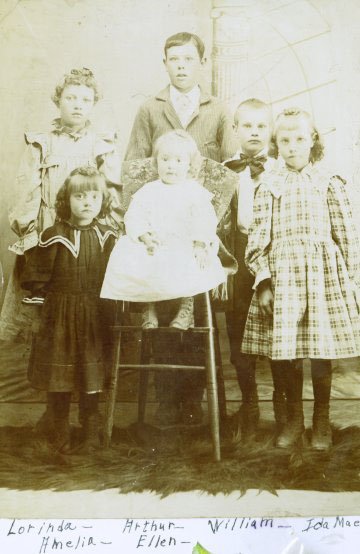
This photo is of the first 6 children when they were young. Left to right is: Amelia in dark dress, Lorinda, Art, Willie, Ida Mae. Ellen is the baby on the stool so the photo would have been taken about 1897-1898.

The family moved to Herbert, about 15 miles southeast of Rexburg, where John took up a homestead for a dry farm. Their last child, Eva was born there.
Everyone shared in the labor whether in the fields or in the house, even the small children. This was a time when there was no motorized farm machinery and all farm work was done by hand and with horses. Houses were small and warmed by wood fires, cooking was done on a wood-fired cook stove or over a fireplace, and there was neither refrigeration nor air-conditioning.


This family photo was taken in 1912, five years after Willie passed away. Some of the older children were married by then.
Left to right at the back is: Joe, Amelia, Ida, Art, Lorinda, Ellen, and George at the far right end.
In the front is John (father), Ted, Emily (mother) and in the center front, leaning on her father, is Eva.

They remained at Herbert until 1915; then, they sold the farm to their son, Arthur, and moved in to Rexburg where they purchased a small home and lot west of Porter Park. They added two rooms on the side where Emily’s mother, Cecelia Anderson, lived until her death.

It was hard work for a woman in the pioneer type of existence they had in their Salem and Herbert homes. Emily cooked over a wood-burning cook stove or, more often perhaps, a fireplace. She baked the bread and churned the butter for the family as well as keeping a garden and feeding her large family with fresh garden produce in the summer. She also had to can and preserve the food so they would have food for the winter. Again, this would have been done over a hot stove with only an occasional breeze to cool her.

She spent many hours collecting sheep’s wool, cleaning and carding it, then spinning it into yarn on a spinning wheel that looked like this illustration. The yarn was used for knitting gloves, socks, sweaters, and other clothing items for the whole family. She also had to construct clothing for the family by hand and she did fancy needlework, made quilts and rugs to make a beautiful as well as useful home. Most travel was done with horses and buggies or wagons. There was no electricity, telephones, automobiles or refrigeration. And there were no electric laundry machines.

Laundry for the family was done with a washtub of water heated on the stove and scrubbed on the ribbed scrubbing board or “washboard”. A plunger was often used to agitate the load, then the clothing was wrung out by hand, rinsed, wrung out again, then hung on a clothesline or on the fence and bushes to dry, then ironed with a heavy flat-iron heated on the stove or fire. It was a very difficult and time-consuming task. There was no time to rest.

John died on 10 June 1920 leaving her a widow for 28 years. During those years, she lived in her home in Rexburg and also in Idaho Falls. Her children spent time with her and often took her places with them. One of her favorite activities was making quilts. She often went to help her daughters and granddaughters when they were quilting. One of the quilts she helped with was a “Dresden Plate” quilt that she helped her granddaughter, Mae Geisler make. She appliquéd the completed pattern onto the background blocks by hand.

She spent much of her last years making quilt blocks, crocheting and doing other needlework for the Relief Society and for her grandchildren and other family members. She suffered a lot from arthritis and had a lot of trouble with her legs and knees. Small children were often cautioned to be careful around her so as not to bump against her legs and her knees because it was so painful for her.

When Emily was in her later years, she often talked with her daughter, Ida, telling her she hoped she didn’t die in the wintertime because it was so cold. Then a body would be put down into that cold earth and it would be SO cold. But she did pass away in the winter, on 5 December 1948. Ida went to the store and found a beautiful, fluffy, white blanket and took it to the funeral home. The mortician helped her wrap her
mother in the white blanket in her casket before the burial. Emily passed away at the age of 84 at Idaho Falls, Bonneville, Idaho and is buried in the Rexburg Cemetery next to John.

Sources of Information
“Life History of Emily Anderson Barber” taken from The Hakan Anderson Families published by the Hakan Anderson Family Organization, 1962.
Illustrations from the collection of C. Mae Galbraith Geisler
Personal interview with C. Mae Galbraith Geisler, August 2006 for some of her personal memories and knowledge of events
Anecdotes and historical information from life history of John Robert Barber
Family information and photos from family group sheets and personal histories and memories of several family members.
Eastern Idaho Death Records at BYU-I Family History website: http://abish.byui.edu/specialCollections/famhist/Obit/searchDetail.cfm#bottom
Compiled by Darline G. Burke, August 2006